

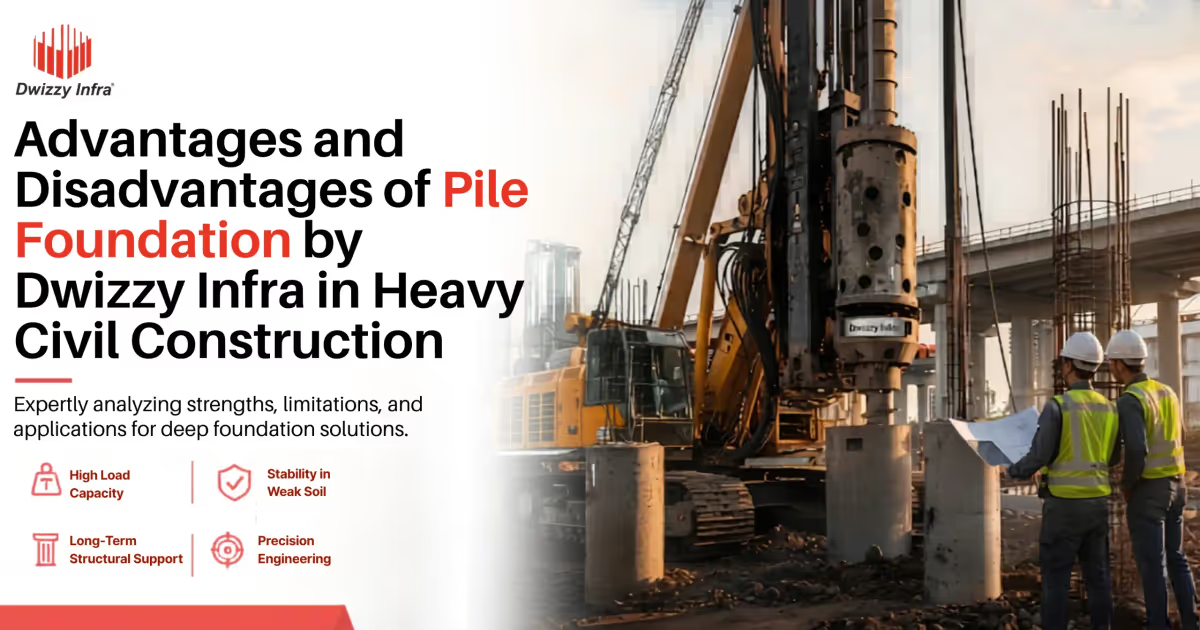
Pile foundations are one of the most critical decisions in any infrastructure project. Whether you're planning a bridge, high-rise, or industrial structure, understanding how deep foundations perform and where they fall short helps engineers and project owners make informed choices. At Dwizzy Infra, pile foundation work is among our core civil services, and we've seen firsthand how this foundation type shapes project outcomes.
What Is a Pile Foundation and When Is It Used?
A pile foundation is a deep foundation system that transfers structural loads through weak or compressible soil layers down to stronger strata or bedrock below. It belongs to the broader category of deep foundations, as opposed to shallow foundations like strip or raft foundations.
Engineers typically specify pile foundations when:
- The soil near the surface has low bearing capacity
- The structure carries heavy vertical or lateral loads
- The site is near a water body or has a high water table
- Settlement control is critical for the structure's function
Common types include bored piles, driven piles, cast-in-situ piles, and precast concrete piles, each suited to different soil conditions and load requirements.
5 Key Advantages of Pile Foundation Systems
1. High Load-Bearing Capacity
Piles transfer loads to deep, competent soil or rock layers. This makes them suitable for structures like bridges, flyovers, and tall buildings where shallow foundations cannot provide adequate support.
2. Effective in Weak or Waterlogged Soil
Sites with soft clay, loose sand, or a high groundwater table are poor candidates for surface-level foundations. Piles bypass these layers entirely, anchoring into stable ground below.
3. Resistance to Uplift and Lateral Forces
Unlike many shallow foundation types, deep piles resist upward forces caused by buoyancy and lateral forces from wind or seismic activity. This is critical in coastal or earthquake-prone regions.
4. Minimal Excavation Required
Driven or bored pile installation requires limited excavation compared to basement or raft foundations. This reduces disruption on constrained urban or waterfront sites.
5. Long Service Life
Properly installed concrete or steel piles embedded in stable soil can perform structurally for decades with minimal maintenance, provided the material and execution meet specifications.
5 Disadvantages of Pile Foundation to Consider
1. Higher Initial Cost
Pile installation requires specialised machinery, boring rigs, pile drivers, or vibratory hammers, and skilled operators. This makes the upfront cost significantly higher than shallow foundation alternatives.
2. Noise and Vibration During Installation
Driven pile methods generate substantial noise and ground vibration. This can be a concern in dense urban areas, near existing structures, or in environments with vibration-sensitive equipment.
3. Risk of Pile Damage During Driving
Precast piles can crack or deviate if driven through boulders or unexpected hard layers. Detecting subsurface obstructions in advance requires thorough geotechnical investigation.
4. Dependent on Accurate Soil Investigation
Pile design depends heavily on soil boring reports and load test data. Incomplete or inaccurate geotechnical data leads to under-designed or over-designed pile systems, both of which carry risk.
5. Difficult to Modify After Installation
Once piles are installed, retrofitting or correcting them is expensive and disruptive. This reinforces the importance of accurate design before execution begins.
Choosing the Right Foundation Type for Your Project
The decision between a pile foundation and other foundation systems depends on site-specific factors, soil profile, structural load, project budget, and construction timeline all play a role.
A qualified geotechnical engineer should review borehole data before specifying the foundation type. For complex or large-scale civil projects, pile foundations often represent the most reliable long-term investment, despite higher upfront costs.
Dwizzy Infra delivers pile foundation solutions across roads, bridges, railways, and heavy civil infrastructure, combining precision execution with certified quality standards. View our completed projects to see how we've applied these systems in real-world conditions.
Frequently Asked Questions Related to Advantages and Disadvantages of Pile Foundation
What are the main advantages of a pile foundation over a shallow foundation?
Pile foundations transfer loads to deep, stable soil or rock, making them suitable for structures where surface soil lacks bearing capacity. They also resist lateral forces, upward pressure, and differential settlement, factors that shallow foundations often cannot handle adequately.
What are the biggest disadvantages of using pile foundations?
The main drawbacks are higher installation cost, noise and vibration during driven pile methods, and dependency on accurate soil investigation. They are also difficult to correct once installed, which makes upfront engineering critical.
When should a pile foundation be used instead of a raft foundation?
A pile foundation is preferred when the soil near the surface is too weak or compressible to support structural loads. Raft foundations work well when load can be spread over a large surface area in relatively stable soil without significant settlement concerns.
How long does a pile foundation last?
A correctly designed and installed concrete or steel pile foundation can last 50 to 100 years or more in stable conditions. Durability depends on material type, soil chemistry, groundwater conditions, and quality of installation.
Does pile foundation work in all soil types?
Pile foundations are adaptable to most soil conditions, including soft clay, loose sand, and waterlogged ground. However, the pile type, depth, and material must be selected based on site-specific geotechnical data, not a one-size-fits-all specification.