

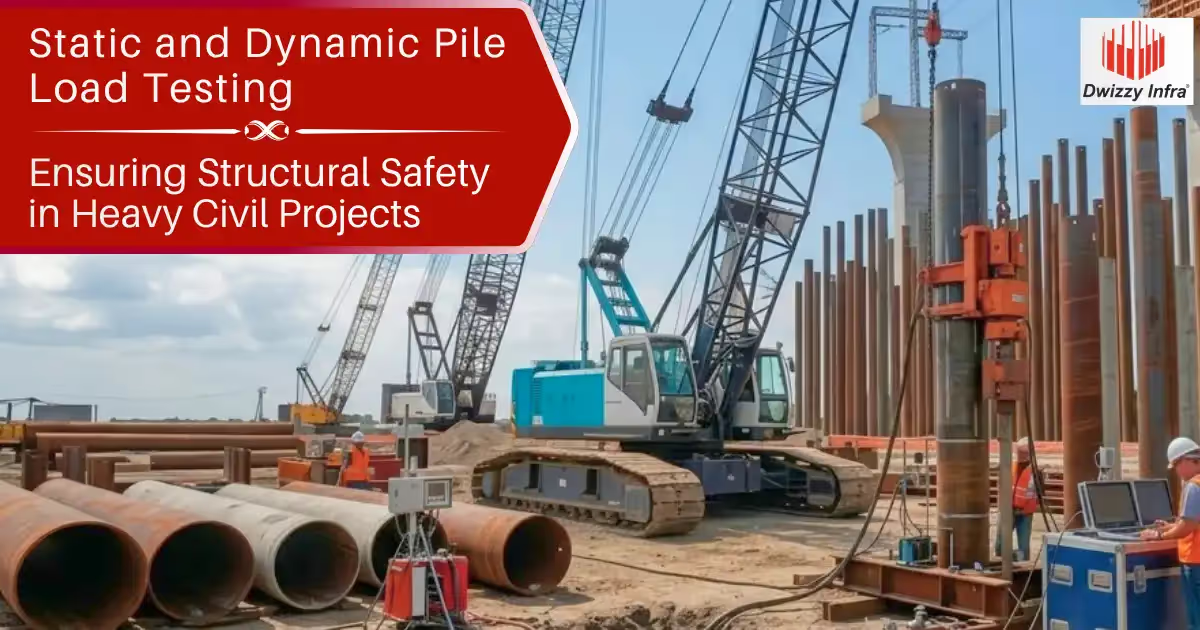
In the realm of heavy civil construction and infrastructure development, the foundation is the silent sentinel of longevity. For massive structures like flyovers, transmission towers, and metro rail systems, the integrity of the sub-surface support dictates the safety of the entire project.
We leverage advanced pile load testing methodologies to verify foundation capacity, mitigate geotechnical risks, and deliver data-driven results for industry leaders across India.
What is Pile Load Testing?
Pile load testing is a field-based geotechnical investigation method used to determine the actual axial compression, tension, or lateral load capacity of a deep foundation element. Unlike theoretical calculations, a pile loading test provides empirical evidence of how the pile interacts with the surrounding soil or rock strata.
For projects involving power transmission line construction or heavy bridge foundations, this test is non-negotiable. It validates design assumptions and ensures the foundation can withstand specified working loads without excessive settlement or structural failure.
Key Types of Pile Load Testing Methodologies
We utilize a combination of testing regimes to suit different soil conditions and project requirements. The selection between static and dynamic methods depends on load magnitude, site accessibility, and the specific phase of construction.
1. Static Load Testing (SLT)
Static load testing is considered the benchmark method for assessing pile capacity. This procedure involves applying a gradually increasing compressive load to the pile head using a hydraulic jack, reacting against kentledge (stacked dead weights) or an anchor pile system.
Settlement is measured against each load increment. This test directly captures load-displacement behavior and provides precise data on elastic and plastic deformation for high-risk projects.
2. Dynamic Load Testing (DLT)
For projects requiring speed and efficiency, dynamic load testing offers a rapid alternative. This high-strain method uses a falling mass (hammer) to strike the pile head while strain transducers and accelerometers measure force and velocity response.
Using the Case Method or wave equation analysis, engineers assess bearing capacity, shaft resistance distribution, and end bearing while checking for defects such as cracks or necking. We use DLT extensively for monopole erection and transmission line foundations where timelines are strict.
3. Rapid Load Testing (RLT) & Bi-Directional (Osterberg Cell) Testing
In specialized scenarios such as offshore installations or sites with limited overhead clearance for kentledge, rapid load testing (ISO 22477-10) or bi-directional testing is employed.
These methods use hydraulic jacks placed within a sacrificial concrete element at the pile toe or along the shaft, enabling independent measurement of end-bearing and skin friction.
Why Pile Load Testing is Critical for Infrastructure Projects
For projects handled by Dwizzy Infra for organizations like L&T, Afcons, and Bajaj Electricals, skipping load testing is never an option. The primary objective is safety.
Unstable soil strata or installation errors can cause sudden settlement or collapse, endangering lives and halting construction. Successful tests also validate design assumptions and often enable optimization in pile length or diameter, creating major cost savings.
Testing additionally provides legal and contractual confidence by proving the foundation meets or exceeds specifications and relevant standards.
Dwizzy Infra's Approach to Foundation Integrity
At Dwizzy Infra, pile load testing is integrated into the quality assurance plan from day one. Whether it is a high-tension transmission tower pile foundation or a railway bridge deep foundation, the process starts with a detailed review of the Soil Test Report (STR).
The team then selects Static, Dynamic, or Rapid testing based on design load requirements and site geology. Using modern hydraulic jacks, reaction beams, and digital displacement sensors, each test is executed with strict procedural control.
Real-time load-settlement curves are analyzed by certified geotechnical engineers to confirm settlement remains within permissible limits, typically 10% of pile diameter or less.
Relevant Testing Standards
- ● ASTM D1143 for static axial compressive load tests.
- ● ASTM D4945 for high-strain dynamic testing.
- ● ISO 22477-10 for rapid load testing applications.
FAQs on Pile Load Testing
What is the difference between a working load test and a pile load test to failure?
A working load test typically applies up to 1.5 to 2 times the safe working load to confirm elastic behavior without excessive settlement. A test to failure continues until plunge or a defined settlement limit (often 10% of pile diameter) to identify ultimate bearing capacity.
How does soil type affect pile load test results?
In cohesive soils such as clay, settlement can be time-dependent and requires longer hold periods. In granular soils like sand or gravel, settlement is mostly immediate. Dynamic testing is often efficient in granular soils, while static tests are critical for validating friction piles in soft clay.
What is the role of the factor of safety in load testing?
The factor of safety, commonly 2.0 to 3.0 for civil structures, is the ratio between ultimate capacity and safe working load. Load tests verify reserve strength to account for variability, corrosion, and unexpected overloads.
Why is pile load testing essential for transmission line projects?
Transmission towers face strong overturning moments from wind and cable tension. Lateral and uplift performance must be validated through targeted testing to prevent excessive deflection and reduce collapse risk during extreme weather.
What is the ASTM standard for high-strain dynamic testing?
The primary standard is ASTM D4945 for evaluating bearing capacity and integrity using high-strain dynamic testing. Static testing commonly references ASTM D1143.
Ensure Your Foundations Are Unshakeable
Do not leave infrastructure safety to guesswork. Partner with Dwizzy Infra for certified, precise, and reliable foundation testing solutions across India.