

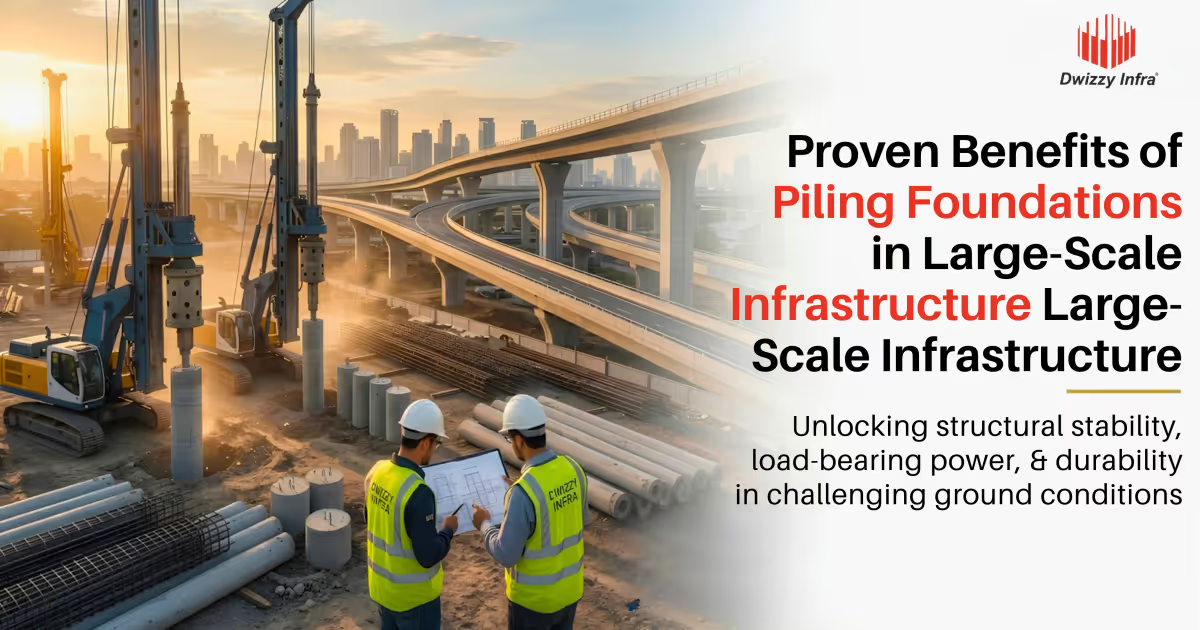
Piling foundations are a critical structural solution for engineers and project owners building on weak, waterlogged, or heavily loaded ground. When surface soils cannot safely bear a structure's weight, deep foundations transfer loads to stronger strata far below ground level.
This article explains the key benefits of pile foundations, the ground conditions that make them necessary, and what engineers and project managers should know before specifying them.
How do Piling Foundations Transfer Structural Load?
A pile is a long, slender structural element, usually made of concrete, steel, or timber, that is driven or cast into the ground. It transfers the building's load either through the tip (end-bearing piles) or along its shaft (friction piles), or a combination of both.
This load transfer mechanism bypasses weak upper soils entirely. The pile reaches competent rock or dense soil layers where bearing capacity is reliably high. That is the fundamental structural advantage pile foundations offer over shallow alternatives like strip or raft foundations.
6 Key Benefits of Using Pile Foundations
1. Reliable Performance on Weak or Compressible Soils
Soft clays, loose sands, and filled land cannot support significant structural loads near the surface. Pile foundations bypass these layers entirely. They anchor structures into dense gravel, hard clay, or bedrock, soils with predictable and proven bearing capacity.
This makes piling the standard choice for coastal construction, riverside infrastructure, and any site where geotechnical investigation reveals poor near-surface conditions.
2. Significant Reduction in Differential Settlement
Differential settlement, where different parts of a structure sink at uneven rates, causes cracking, misalignment, and in severe cases, structural failure. Pile foundations dramatically reduce this risk.
Because each pile reaches consistent load-bearing strata, the settlement across the structure remains uniform and predictable. This is especially important for bridges, industrial buildings, and high-rise towers, where even minor differential movement has consequences.
3. High Load-Bearing Capacity for Heavy Structures
Large-diameter bored piles or steel H-piles can carry axial loads of several hundred tonnes per pile. Shallow foundations simply cannot match this capacity.
Infrastructure like power transmission towers, highway bridges, and large-span industrial sheds demands foundations that handle both vertical loads and lateral forces from wind and seismic activity. Piling systems are engineered to meet these combined demands reliably.
4. Suitability for High Water Table Conditions
Sites with a high groundwater table present construction challenges for excavation-based foundations. Pile installation, particularly bored or driven piles, avoids deep open excavations, reducing dewatering costs and ground instability risks.
This is a significant practical advantage on river, port, and coastal projects where groundwater management adds both cost and programme risk.
5. Resistance to Uplift and Lateral Forces
Friction piles and under-reamed piles provide resistance not just to downward loads but also to uplift forces. Structures subject to hydrostatic uplift, wind uplift, or seismic lateral loads need foundations that anchor into the ground rather than simply rest on it.
Telecommunication towers, transmission line structures, and tall chimneys all rely on this characteristic.
6. Long-Term Durability with Low Maintenance
Reinforced concrete piles, when properly designed and installed, have service lives exceeding 50–100 years. They require no periodic maintenance once installed, unlike some shallow foundation repair scenarios involving grouting or underpinning.
This long-term cost efficiency makes piling attractive even on sites where shallow foundations might technically work, provided the ground conditions are borderline.
When Engineers Specify Pile Foundations Over Shallow Alternatives
The decision to use deep foundations is driven by geotechnical data. A soil investigation report showing low standard penetration test (SPT) values, high compressibility, or expansive clay layers will typically lead structural engineers to specify piles.
Other triggers include: structures with heavy point loads, sites adjacent to existing infrastructure where excavation is restricted, and buildings sensitive to settlement such as hospitals or data centres.
Pile load testing confirms the actual in-situ performance of installed piles. Our pile load testing guide explains the test types and what the results mean for foundation design.
Common Types of Pile Foundations Used in India
- Bored cast-in-situ piles, drilled and poured on-site, are used where vibration must be minimised.
- Driven precast piles, manufactured off-site and hammered into the ground; faster installation.
- Micro-piles, small-diameter piles for restricted access or underpinning work.
- Under-reamed piles, enlarged base piles suited to expansive soils common in many Indian regions.
Each type suits different soil profiles, load requirements, and site constraints. The selection is always based on geotechnical investigation and structural design, not general preference.
FAQs About the Benefits of Piling Foundations in Construction Projects
What are piling foundations used for?
Piling foundations are used to transfer structural loads from a building or infrastructure element down to stronger, deeper soil layers or bedrock. They are specified when near-surface soils are too weak, compressible, or unstable to safely support the structure through conventional shallow foundations.
How deep do pile foundations typically go?
Pile depth depends on the site's soil profile and the load being transferred. In practice, piles for residential and medium commercial structures range from 5–15 metres. For heavy infrastructure like bridges or industrial plants, depths of 20–40 metres or more are common where competent strata lie deep below the surface.
Are pile foundations more expensive than shallow foundations?
Pile foundations generally have a higher upfront construction cost than strip or raft foundations. However, on sites with poor soil conditions, the cost of building a shallow foundation to an adequate standard, including ground improvement, underpinning risk, or remedial work for future settlement, often exceeds the cost of piling from the outset.
How long does it take to install pile foundations?
Installation time depends on the number of piles, their diameter and depth, and the equipment used. A straightforward bored pile programme for a medium-scale building might take one to three weeks. Larger infrastructure projects with hundreds of piles are typically scheduled over several months, integrated into the broader construction programme.
What soil conditions require piling?
Soft clays, loose fills, waterlogged ground, liquefiable sands, and expansive clays are common soil conditions that require piling. Sites near rivers, coastal areas, and former low-lying land in urban areas frequently encounter these conditions. A geotechnical investigation report will confirm whether piling is necessary for a specific site.